Peru, Reimagined by AI 秘鲁,被AI重新想象
From Machu Picchu souvenirs to state-backed travel apps, AI is unevenly changing how Peru is represented, promoted, and encountered. 从马丘比丘纪念品到政府支持的旅行应用,AI 正以不均衡的方式改变秘鲁被呈现、被推广和被游客邂逅的方式。
 01Machu Picchu马丘比丘
  02Machu Picchu马丘比丘
  03Machu Picchu马丘比丘
  04Rebeca
 While travelling in Peru, I rarely saw AI directly. Across Lima, Cusco, and Machu Picchu, tourism still appeared to operate through familiar arrangements: guides, agencies, hotel desks, printed menus, souvenir shops, and conversations between people.
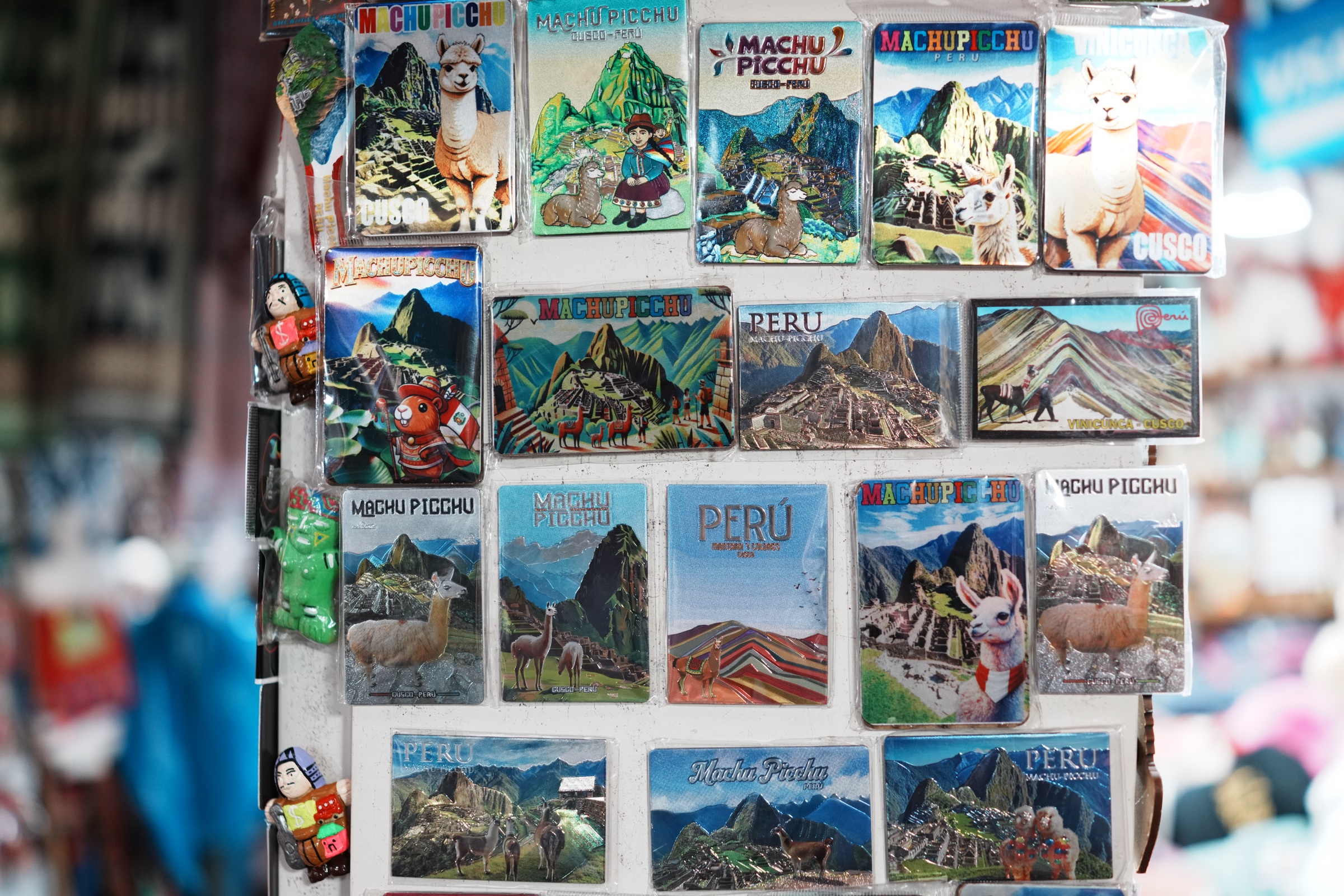
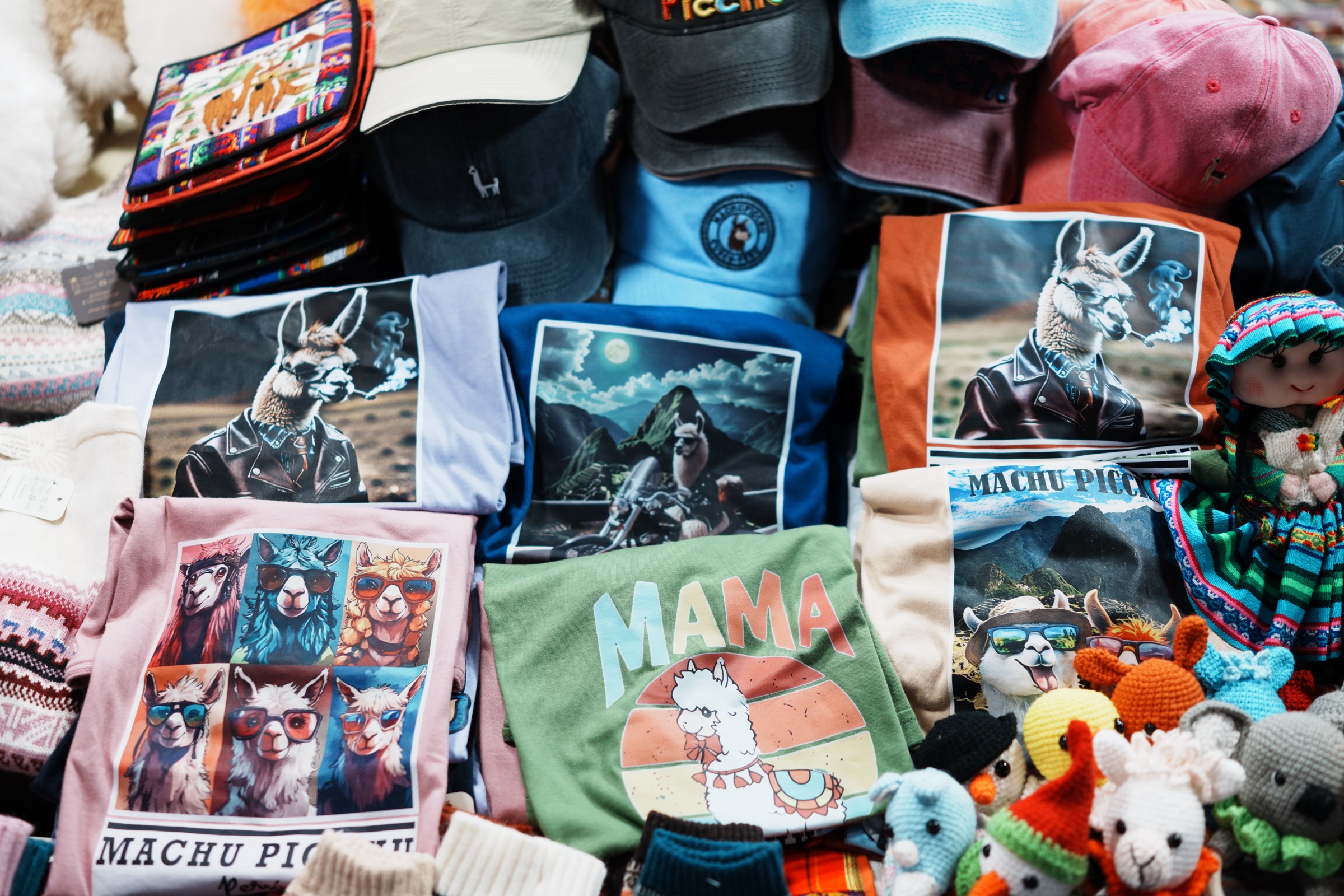
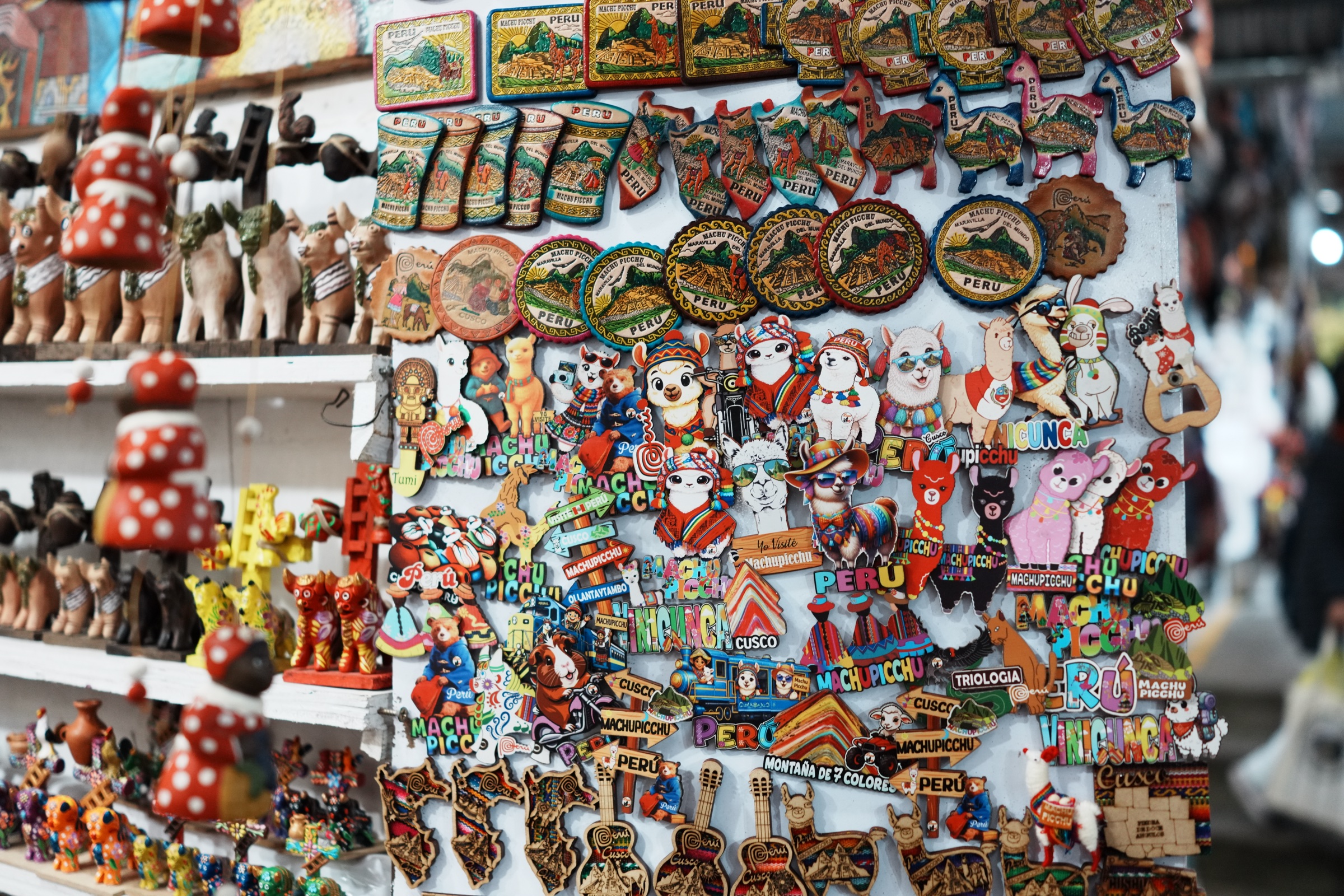
Yet difficulty seeing it did not mean that it was absent. In a souvenir shop near Machu Picchu, magnets repeated familiar mountains, llamas, and Inca signs. On T-shirts, llamas wore leather jackets, rode motorcycles, and entered exaggerated fantasy scenes. Tourism symbols were separated, recombined, and packaged as an image of Peru that was easy to recognise, share, and buy.
The finished products do not reveal how they were made. They may have been drawn by human illustrators, produced with ordinary digital tools, or assisted by AI. A photograph cannot establish provenance. It can, however, raise a different question: as generative images enter design and commodity production, what version of Peru will be repeatedly generated, recognised, and purchased?
Research on tourism images finds that generative AI can compress destinations into a narrow set of landmarks, colours, and cultural signs. Experimental work on AI-designed souvenirs likewise finds that people tend to perceive them as less authentic than human-designed ones. AI can produce the appearance of place quickly without necessarily preserving its complexity.
At this micro scale, AI is an encountered presence and a social appearance. The traveller does not enter a complete AI system. Instead, one meets possible traces: a fantastic llama, a familiar synthetic style, or a souvenir whose production cannot be verified. These objects communicate a Peru that is ancient, mysterious, colourful, playful, and available for consumption. Whether or not AI helped make them, tourist sites are dense markets for visual novelty. A synthetic style that may already feel overfamiliar in an image-saturated setting can still function as a novelty in a souvenir shop. Its visibility follows local aesthetic and commercial rhythms rather than a smooth diffusion of technology. This is Peru reimagined as a compact visual vocabulary—less a complete place than a set of signs ready to circulate.
Rebeca expresses a larger-scale promise. The AI travel application calls itself a traveller's “best local friend.” It offers text and voice conversation, itinerary planning, maps, less crowded places, and personalised recommendations. In this interface, Peru is reimagined as a destination that can be discovered through conversation. In July 2026, ProInnóvate, a programme of Peru's Ministry of Production, reported that Euler Innovations had received S/ 364,940.67 in non-reimbursable public funding to develop and validate the platform. The project was intended to connect travellers with tourism businesses and communities in Arequipa, Cusco, Ica, and Lima.
A small application thus carries a large message: Peru can be discovered through conversation, and tourism can become intelligent, personalised, sustainable, and more geographically dispersed. But a promise is not the same as an outcome. Rebeca's App Store page does not yet have enough ratings to display an overview, while incomplete third-party Android records place downloads only in the low hundreds. These figures cannot establish its full user base. They do show that the project's policy visibility is much larger than its publicly observable adoption.
Rebeca also shows the transnational structure of Peruvian AI innovation. Its founder, Sergio Sotelo, was born in Peru and later entered U.S. business and innovation networks. Euler describes itself as a firm connecting the United States and Peru. Local tourism knowledge and Peruvian public funding are combined with company, professional, and technical resources assembled abroad. AI opportunity is therefore organised through relational proximity, not physical distance alone. An entrepreneur can work on a Peruvian problem yet become closer to opportunity by entering U.S. capital, education, platform, and professional networks. The inequality is not simply Peru versus the United States. It lies in who can bridge them, turn local knowledge into a credible technical project, and attract resources.
Rebeca is not Peru's national tourism strategy by itself. In April 2026, the Ministry of Foreign Trade and Tourism and PROMPERÚ introduced a separate AI travel assistant on the official Peru Travel platform, linking personalised planning to international promotion and the diversification of destinations. Rebeca is better understood as one state-backed experiment: limited in scale, but capable of giving a broader ambition an interface that can be seen, downloaded, and addressed.
AI therefore enters Peru's tourism industry at two scales. At the micro scale, it participates in images, commodities, and tourist memory. At the macro scale, it enters applications, public funding, and national development language. These scales describe where AI appears; its uneven geography has two further layers. The first is spatial heterogeneity: AI differs in visibility, form, and function among ordinary tourism spaces, commercially strategic nodes, and policy interfaces. The second is spatial inequality: where those differences overlap with unequal access to capital, skills, platforms, and transnational networks, some actors become better able to produce images, secure resources, and decide how Peru will be represented. Peru, reimagined by AI, is not yet an everywhere-visible industrial reality. It is an emerging way of seeing: before travellers fully see AI, it is already changing how they see Peru.
在秘鲁旅行时,我很少直接看到 AI。走过利马和库斯科,再到马丘比丘,旅游业仍然主要通过导游、旅行社、酒店前台、纸质菜单、纪念品商店,以及人与人之间的介绍来运作。
但难以看见,并不意味着它没有到来。在马丘比丘附近的一家纪念品商店里,冰箱贴重复着熟悉的山峰、羊驼与印加符号;T 恤上的羊驼则穿上皮夹克、骑着摩托车,进入夸张的奇幻场景。传统旅游符号被拆开、重组,再包装成一种容易识别、分享和购买的“秘鲁感”。
仅凭这些成品,我们无法判断它们是否由生成式 AI 制作。它们可能出自人类插画师,也可能经过普通数字工具或 AI 辅助。照片不能证明生产方式,却可以提出另一个问题:当生成式图像进入设计与商品生产流程,什么样的秘鲁会被反复生成、识别和购买?
相关研究发现,生成式 AI 容易把旅游目的地压缩成少数地标、色彩与文化符号;消费者也往往认为 AI 设计的纪念品不如人类设计的产品真实。AI 可以快速生产地方风格,却未必能够呈现地方的复杂性。
因此,AI 在这里首先是一种社会表象和偶遇性存在。游客并没有进入一个完整的 AI 系统,而是在一只奇幻羊驼、一种似曾相识的图像风格,或者一件无法确认其生产方式的商品上,碰到 AI 可能留下的痕迹。它所传达的是一个古老、神秘、色彩鲜明,同时又轻松而可消费的秘鲁。无论这些商品是否真的使用了 AI,旅游景点本身都是视觉新奇感的密集市场。同一种合成图像风格,在图像技术密集的环境中可能很快造成审美疲劳,在纪念品商店里却仍可能成为卖点。它在哪里变得可见,取决于地方审美与商业节奏,而不是技术均匀扩散的结果。这是一个被重新想象为视觉词汇的秘鲁:不再是完整的地方,而是一组可以流通的符号。
如果说纪念品呈现了微观尺度,那么 Rebeca 则表达了宏观尺度上的愿景。这款 AI 旅行应用把自己称为游客“最好的当地朋友”,可以通过文字或语音规划行程、浏览地图、寻找游客较少的地点,并提供个性化推荐。在这个界面里,秘鲁被重新想象成一个可以通过对话逐步发现的目的地。
2026 年 7 月,秘鲁生产部下属的 ProInnóvate 宣布,Euler Innovations 获得约 364,940.67 秘鲁索尔的不可偿还公共资金,用于开发和验证 Rebeca。官方希望它连接游客与阿雷基帕、库斯科、伊卡和利马的旅游企业及地方社区。一个很小的应用,由此承载了一个更大的承诺:让秘鲁旅游变得智能、个性化、可持续,也让较少被看见的地方进入游客的选择范围。
然而,公共愿景与实际采用之间仍有距离。Rebeca 在 Apple 应用商店中尚没有足够的评分形成概览,第三方记录的 Android 下载量也仅在数百次范围。后一个数字不完整,不能代表全部用户,却提示我们:一个项目可以在政策语言中代表旅游业的未来,同时仍只有很小的公共使用足迹。
Rebeca 也体现了秘鲁 AI 创新的跨国结构。创始人 Sergio Sotelo 出生于秘鲁,后来进入美国的企业与创新网络;Euler Innovations 则把自己描述为连接美国与秘鲁的 TravelTech 企业。秘鲁的旅游问题、地方知识和公共资金,在这里与境外的公司环境和技术资源结合。AI 机会因而取决于一种关系上的接近,而不只是物理距离:一个人可以身在秘鲁、处理秘鲁的问题,却因为进入美国的资本、教育、平台和专业网络而更接近机会。不平等不只是秘鲁与美国之间的差距,也存在于谁能够连接两地、把地方知识转化为可信的技术项目,并由此获得资源。
Rebeca 并不等同于秘鲁的整个国家战略。2026 年 4 月,秘鲁对外贸易和旅游部与 PROMPERÚ 在官方 Peru Travel 平台上推出了另一款 AI 旅行助手,把个性化规划、国际推广和目的地多元化纳入旅游数字化政策。Rebeca 更适合被理解为国家支持的一项具体实验:规模有限,却让宏观愿景获得了一个可以下载、观看和对话的界面。
AI 对秘鲁旅游业的影响,由此出现在两个尺度上。微观上,它进入图像、商品和游客记忆;宏观上,它进入应用、公共资金和国家发展话语。两个尺度描述 AI 在哪里出现;不均衡地理则进一步包含两层含义。第一层是地理分布与表现形式的异质性:在一般旅游空间、具有商业价值的旅游节点和政策界面中,AI 的可见度、形态和功能并不相同。第二层是地理不平等:当这些差异与资本、技能、平台和跨国网络的不平等分配重叠时,一些主体就更有能力生产图像、获得资源,并决定秘鲁如何被呈现。这个“被 AI 重新想象的秘鲁”还不是一种随处可见的产业现实,而是一种正在形成的观看方式:在游客真正看见 AI 之前,它已经开始改变他们看见秘鲁的方式。
Endnote尾注
- Field photographs and Rebeca interface screenshot by the author, August 2026.
- Tourism destination stereotypes in generated images: Hanxiang Zhu et al., “Tourism Destination Stereotypes and Generative Artificial Intelligence (GenAI) Generated Images”, Current Issues in Tourism (2024).
- Perceived authenticity of AI-designed souvenirs: Hyunsu Kim, Seunghun Shin, and Hyejo Hailey Shin, “Enhancing the Authenticity of Artificial Intelligence (AI)-Designed Souvenirs”, Journal of Hospitality & Tourism Research (first published online 2025).
- On uneven AI adoption across places, sectors, and firms: Sandrine Kergroach and Julien Héritier, Emerging Divides in the Transition to Artificial Intelligence, OECD Regional Development Papers no. 147 (2025).
- Rebeca's public funding, project regions, and intended tourism functions: ProInnóvate, project results announcement (22 July 2026).
- Public product description and limited rating visibility: Apple, Rebeca | Digital Companion. The low-hundreds Android figure comes from an incomplete third-party snapshot by Chrome-Stats and is not a measure of total or active users.
- Sergio Sotelo and Euler Innovations' U.S.–Peru positioning: Sergio Sotelo, “About”.
- Peru's official tourism assistant: Ministry of Foreign Trade and Tourism, Mincetur and PROMPERÚ launch announcement (7 April 2026).
- 田野照片与 Rebeca 界面截屏由作者摄制于 2026 年 8 月。
- 关于生成式图像中的旅游目的地刻板印象:Hanxiang Zhu 等,“Tourism Destination Stereotypes and Generative Artificial Intelligence (GenAI) Generated Images”,Current Issues in Tourism,2024。
- 关于 AI 设计纪念品的感知真实性:Hyunsu Kim、Seunghun Shin 与 Hyejo Hailey Shin,“Enhancing the Authenticity of Artificial Intelligence (AI)-Designed Souvenirs”,Journal of Hospitality & Tourism Research,2025 年网络首发。
- 关于 AI 在不同地点、行业与企业之间的不均衡采用:Sandrine Kergroach 与 Julien Héritier,Emerging Divides in the Transition to Artificial Intelligence,OECD Regional Development Papers no. 147,2025。
- Rebeca 的公共资助、项目地区与旅游功能:ProInnóvate,项目成果公告,2026 年 7 月 22 日。
- 产品功能与有限的评分可见度:Apple,Rebeca | Digital Companion。Android 的数百次下载来自 Chrome-Stats 的不完整第三方快照,不代表全部用户或活跃用户。
- Sergio Sotelo 与 Euler Innovations 对自身美国—秘鲁关系的介绍:Sergio Sotelo,“About”。
- 秘鲁官方旅游助手:秘鲁对外贸易和旅游部,Mincetur 与 PROMPERÚ 发布公告,2026 年 4 月 7 日。