When the Young Build AI, AI Begins to Care for the Old 当年轻人开发 AI,AI 开始照顾老人
The Two Geographies of Seoul’s AI City 首尔 AI 城市的两种地理
Where AI is made
AI 的生产现场
firms · research · testbeds
企业 · 研究 · 试验场
Where AI reorganises life
AI 进入生活之处
work · care · relation
劳动 · 照护 · 关系
Just after landing at Incheon Airport, I encountered an information screen asking: “May AI Help You?” It adapted one of the most ordinary phrases in the service economy by replacing I with AI. The change was small, but the proposition was clear: assistance in this city need not come from a person. It might also come from an interface, a system, or a model.
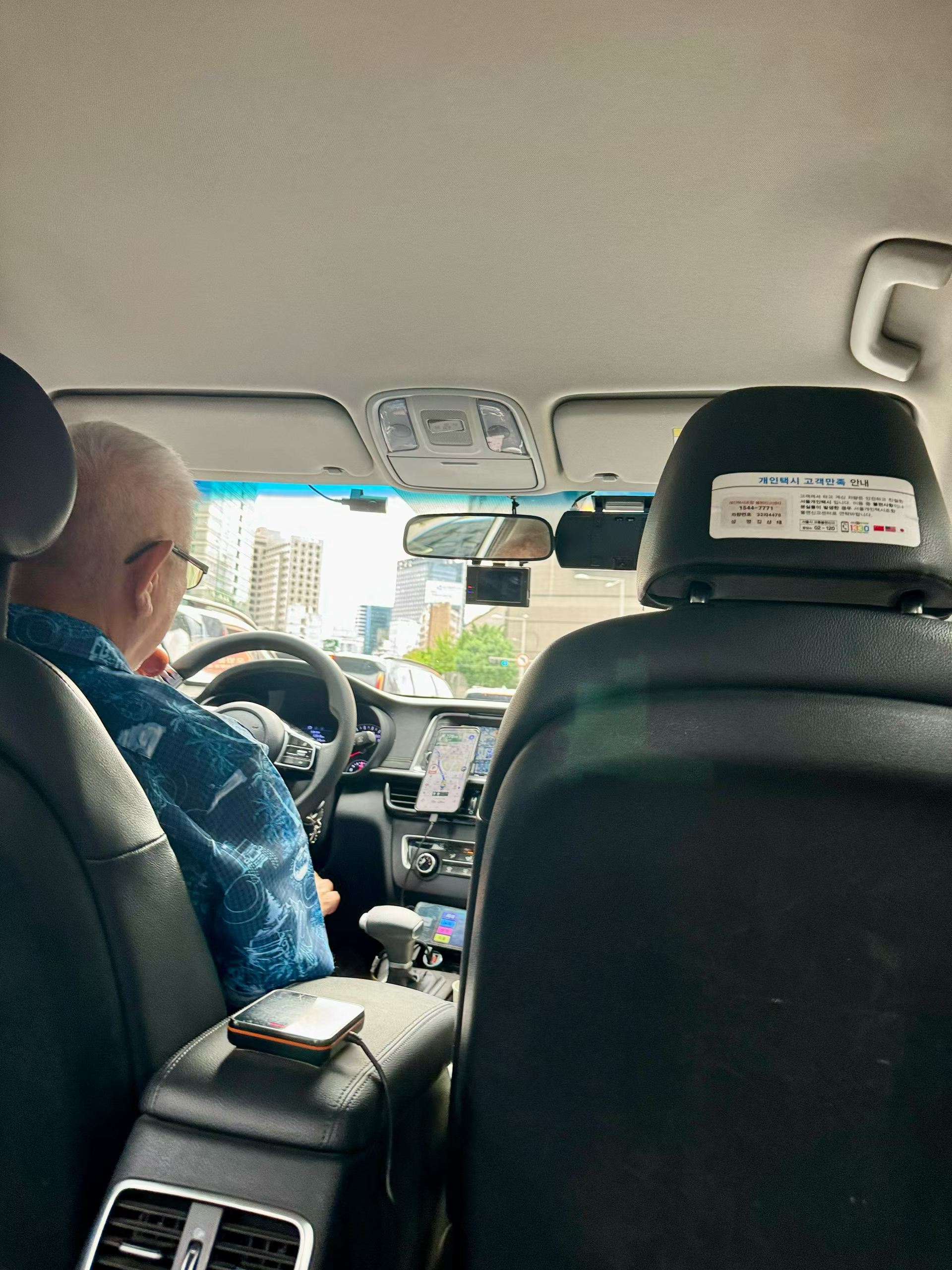
Outside the terminal, my taxi driver was an older man with white hair. We did not share a language. He placed a phone on the dashboard and opened live translation. The results were uneven but sufficient to sustain a conversation. We talked about the weather, traffic, and where we had come from. AI did not replace anyone in the car. It intervened between us and made an exchange possible that otherwise would have been difficult.
I saw similar arrangements elsewhere: older drivers continuing to work through phones, navigation systems, and platform interfaces. Technology helped them work, but it also became part of the conditions under which work could continue. Once a platform enters the labour process, adapting to technology is no longer entirely a personal choice.
This became my starting point for understanding Seoul as an AI city. Within the same city are two connected but markedly different AI geographies. One produces, plans, and displays AI. The other uses and adapts to AI, while absorbing the changes that follow when it enters everyday life. These geographies do not place the same people or activities on a single plane, nor does every technology in the first travel directly into every site in the second. Their connection lies in a change in how the city operates: systems produced as innovation are becoming conditions of work, social connection, and care. At its sharpest, young people are employed to build AI while AI begins to assume some of the care once expected of younger family members.
Seoul has put forward the idea of becoming a “global AI innovation city.” It seeks to expand its AI industrial clusters, develop robotics, and make the city itself a place where technologies are researched, tested, and applied. NAVER 1784 is one expression of that ambition.
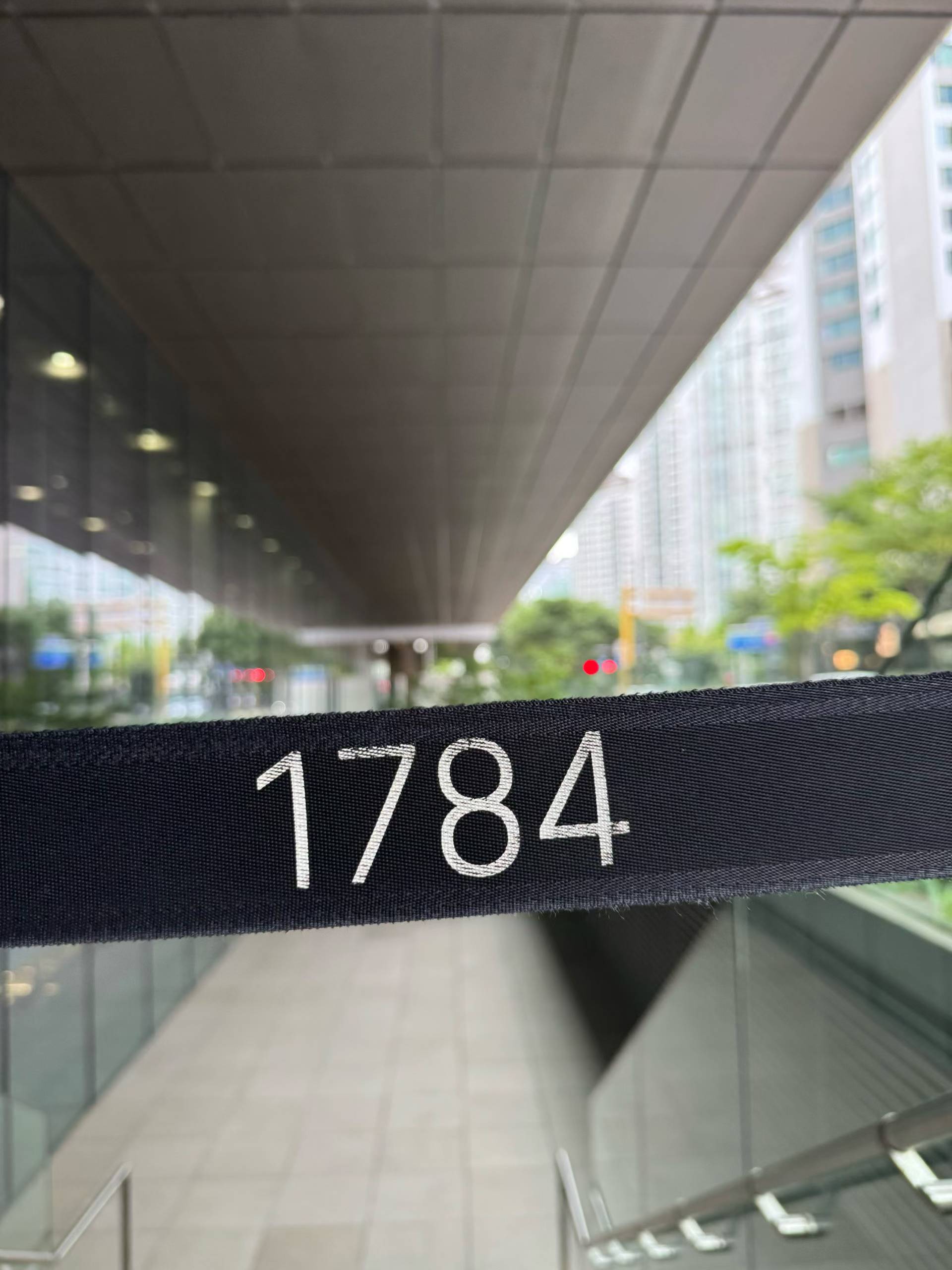
NAVER is South Korea’s dominant internet platform and one of its principal AI companies. The name “1784” refers both to the site’s former lot number, 178-4, and to the company’s historical narrative, in which 1784 marks the beginning of the first Industrial Revolution. NAVER calls the headquarters a testbed for the next one.
Inside, the future-city exhibition places digital twins, maps, robots, cloud computing, and technology-assisted health assessment in a single space. Robots move through the building, cloud systems coordinate them, and digital models provide spatial reference. Beyond the exhibition, through glass, young employees continue to work. Demonstration and production occupy the same field of view.
The prevailing impression is not futuristic spectacle so much as institutional confidence. The building does not ask visitors to imagine a future detached from the present; it offers its own workplace as the sample. Models, maps, robots, cloud platforms, and employees form one production system. AI is not merely an end product used by the city. It is becoming infrastructure for developing, deploying, and managing other technical systems. This is a geography in which AI produces AI. The young employees visible beyond the glass are therefore more than background. Their labour gives this first geography its social form: young people are at work developing AI and the systems around it.
Once technology leaves the exhibition hall and enters society, however, what becomes visible is no longer only technical capacity. It is also the reorganisation of existing social relations. Older gay men are an especially important group through which to understand this change.
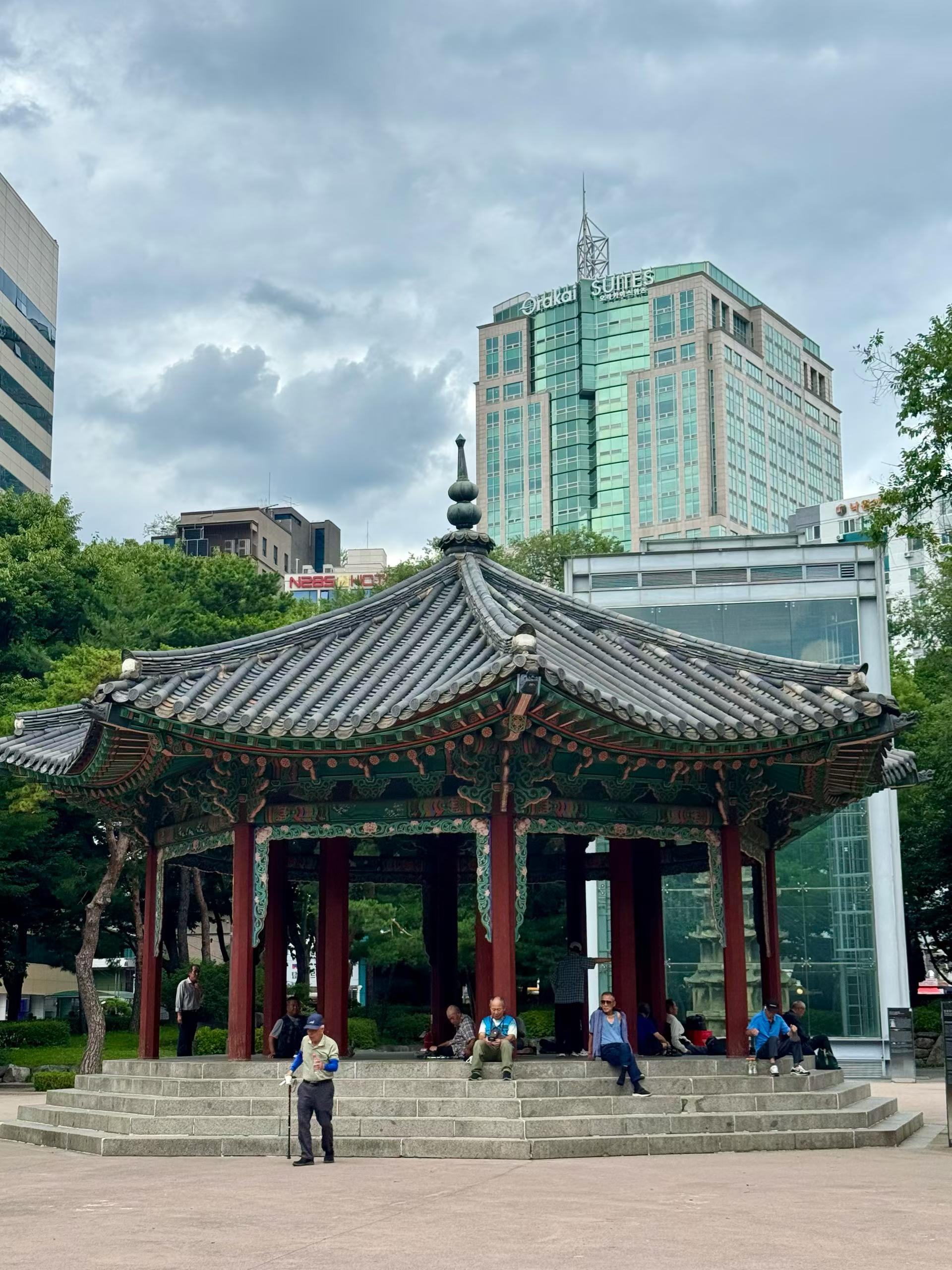
Jongno 3-ga has long contained a discreet gay community. Bars, restaurants, old cinemas, and meeting places are embedded in otherwise ordinary streets. Research on the district suggests that low visibility does not signify exclusion alone. In a relatively conservative social setting, it can also be a practical arrangement for protecting privacy, sustaining relations, and allowing a community to endure.
Many younger queer people now use apps to connect recognition on a screen with bars, streets, and meeting places. Older people use digital tools as well, but digital connection does not open the same urban pathways for everyone. For some, an online connection extends quickly into several physical spaces. For others, a limited number of familiar places still carry more of the work of finding one another, confirming identity, and sustaining companionship.
The same reorganisation becomes more direct in elder care. South Korea’s low birth rate and ageing population are making existing arrangements of intergenerational care increasingly difficult to sustain. Work once carried mainly by children, relatives, and communities is being redistributed among welfare agencies, platforms, sensors, and companion robots.
Hyodol is one example. The child-shaped companion robot, designed for older adults living alone, can prompt medication and daily routines, maintain simple conversation, and connect a user to a wider care network. Research records emotional support and social participation, but also dependence, frustration, and anxiety. The machine does not remove care. It changes its medium and redistributes responsibility among older people, relatives, welfare workers, companies, and platforms.
This arrangement exposes a broader tension. The young employees working inside companies such as NAVER belong to an economy that produces AI systems; companion robots represent the broader technical economy’s response to a shortage of care. Yet the young people who develop AI systems are not thereby available to provide daily care themselves. Paid work limits the time available for care within the household, while technology is asked to assume some of the presence once expected of younger family members. This does not describe every family, nor did AI cause the retreat of intergenerational care. It identifies a possibility that has already become real and institutionally supported: part of care can now be delegated to a machine.
These cases show that AI does not enter an empty space awaiting a technical solution. It enters a society already marked by low fertility, population ageing, loneliness, and unequal relations. It can ease particular difficulties while giving existing problems new forms. Loneliness can be monitored, conversation simulated, and care coordinated at a distance. In this sense, AI does more than automate tasks. It reorganises emotional relations by changing who—or what—is expected to be present, who bears responsibility, and who receives sustained attention.
The two maps therefore depict not two cities, but two positions within the same city. One concentrates the capacity to define problems, design systems, and imagine the future. The other is inhabited by people who use those systems, adapt to them, and remain only partly legible to them. The distinction is not simply one between young and old, but between positions in a production system: those with greater power to shape its technologies, and those whose lives are increasingly organised through them.
The two geographies are not separate. The models, platforms, and machines produced in the first enter the labour, intimate relations, and care arrangements of the second. The relevant question is not who is advanced and who is behind. It is who can participate in deciding what AI should recognise as a problem, what needs it should meet, and which relations it should regard as worth sustaining.
Seen in this light, the airport’s question is more than a light piece of wordplay. AI can certainly help; the live translation in the taxi already demonstrated that. The harder questions are what counts as help, under what conditions it is provided, and who gets to decide.
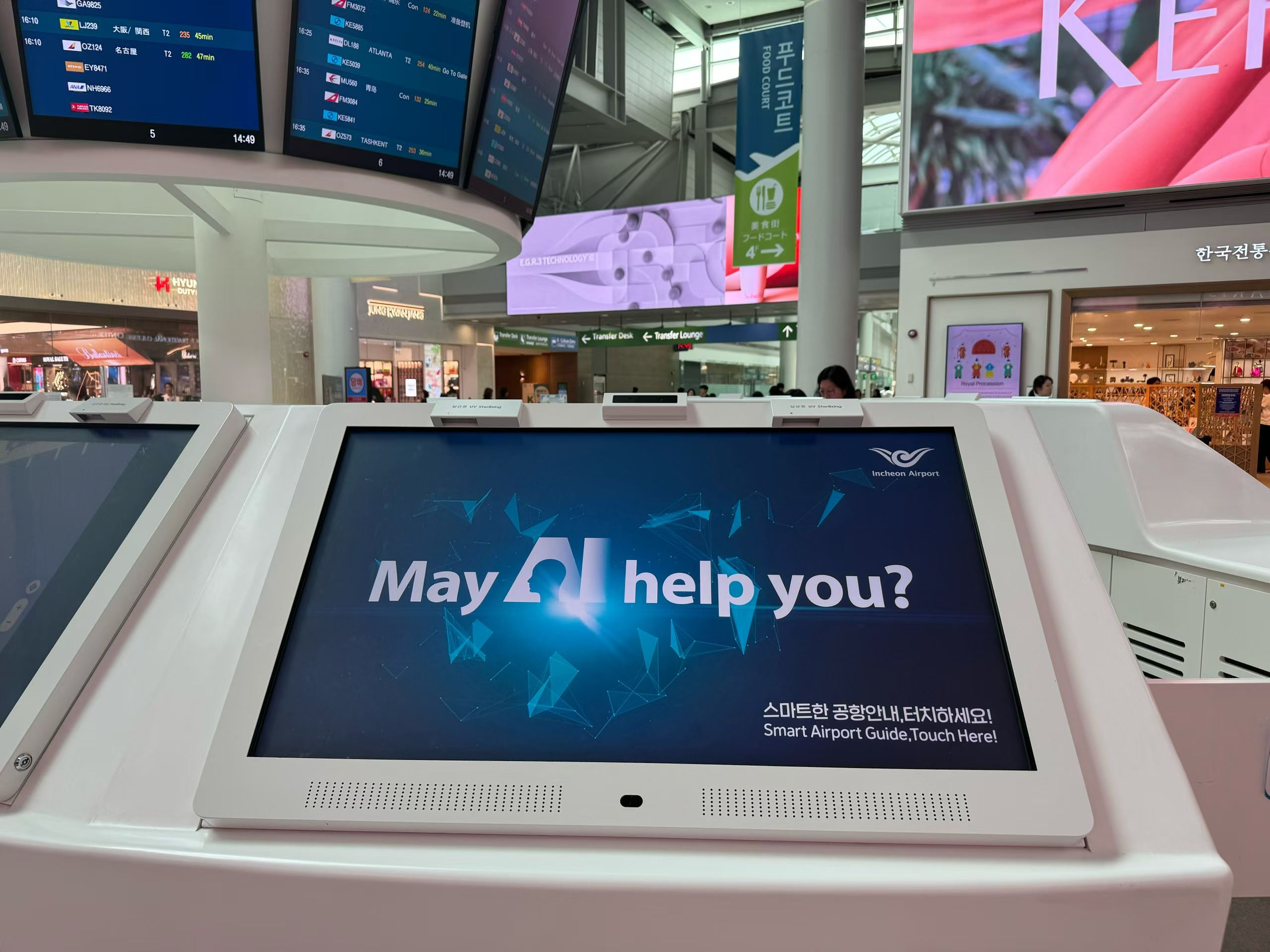
刚在仁川机场落地,我便看到一块信息屏问:“May AI Help You?” 它改写了服务业里再普通不过的一句话,只把 I 换成了 AI。改动很小,意思却很明确:在这座城市里, 提供帮助的未必是人,也可能是一个界面、一套系统或一个模型。
走出机场,我坐上一辆出租车。司机头发花白。我们语言不通, 他把手机固定在驾驶台上,打开实时翻译。翻译并不总是准确,却足以维持一段交谈。 我们谈天气、交通,也谈各自从哪里来。AI 没有取代车里的任何人, 只是充当翻译,让一段原本难以发生的交谈得以继续。
此后,我还看到不少类似的场景:年长司机借助手机、导航和平台界面继续工作。 技术给他们提供了帮助,也逐渐成为继续工作的必要条件。 一旦平台进入劳动过程,适应技术也就不再完全是个人选择。
这成为我理解首尔这座 AI 城市的起点。同一座城市里,存在着两种彼此连接、 又很不相同的 AI 地理。一边生产、规划和展示 AI;另一边使用并适应 AI, 也承受它进入日常生活之后带来的变化。两者之间不存在从某家公司到某项服务的 简单直线,但它们共同改变着城市的运行方式:以创新之名开发的系统, 正逐渐成为劳动、社会交往和照护的基础条件。最鲜明的场景是,年轻人受雇 开发 AI,而 AI 开始承担过去往往由年轻家庭成员提供的一部分照护。
首尔提出了建设“全球 AI 创新城市”的目标,希望扩大 AI 产业集群、 发展机器人产业,并把城市本身变成技术研发、测试和应用的场所。 NAVER 1784 正是这种城市构想的代表之一。
NAVER 是韩国占主导地位的互联网平台,也是该国最重要的 AI 企业之一。 “1784”一方面来自这块土地原来的地号“178-4”,另一方面承载着公司赋予它的 历史寓意:1784 年被视为第一次工业革命的开端。NAVER 因而把这座总部称为 下一轮工业变革的试验场。
进入大楼,未来城市展览把数字孪生、地图、机器人、云计算和技术辅助的健康检测 放在同一个空间里。机器人在楼内移动,云端系统负责调度,数字模型为它们 提供空间参照。隔着玻璃,年轻员工仍在工作。展厅与办公室出现在同一视野中, 技术演示与日常生产并未被刻意分开。
这里给人的主要印象并不是科幻感,而是一种制度性的自信。大楼不要求访客想象 一个与现实隔绝的未来,而是直接把自身的工作场所作为示范。模型、地图、 机器人、云平台和员工共同组成了一套生产系统。AI 不只是城市最终使用的产品, 也逐渐成为研发、部署和管理其他技术系统的基础设施。这里形成了一种“AI 生产 AI” 的地理。玻璃后面的年轻员工并不只是背景;正是他们的劳动,让这套生产体系 真正运转起来。年轻人在这里开发 AI,也开发着围绕 AI 运行的技术系统。
当技术离开展厅、进入社会,显现出来的就不再只是技术能力, 还有它对既有社会关系的重新安排。年长男同性恋者的处境, 为理解这种变化提供了一个重要视角。
钟路三街长期存在着一个低调的男同性恋社群。酒吧、餐馆、旧影院和见面场所 散落在普通街巷之中。相关研究指出,不显眼并不只意味着受到排斥。 在较为保守的社会环境中,它也可能是一种保护隐私、维系关系和延续社群的生存方式。
今天,许多年轻酷儿可以通过 App,从屏幕上的相识走向酒吧、街道和其他见面场所。 年长者同样会使用数字工具,但数字连接为不同人打开的城市路径并不相同。 对一些人而言,线上联系可以迅速延伸到多个线下空间;对另一些人而言, 为数不多的熟悉场所,仍然承担着寻找彼此、确认身份和维持陪伴的重要作用。
在老年照护中,这种变化表现得更加直接。韩国的少子化与人口老龄化, 使原有的代际照护关系越来越难以维持。过去主要由子女、亲属和社区承担的部分工作, 如今开始转交给福利机构、数字平台、传感器和陪伴机器人。
Hyodol 就是一个例子。这种为独居老人设计、采用儿童外形的陪伴机器人, 可以提醒服药和日常活动,与使用者进行简单对话,并把老人接入更大的照护网络。 相关研究既记录了它带来的情感支持和社会参与,也发现了依赖、挫折与焦虑。 机器人并未取代照护,而是改变了照护发生的方式,并在老人、亲属、 福利人员、企业和平台之间重新分配责任。
这种安排也显露出更大的张力。NAVER 等企业里的年轻人参与生产 AI, 陪伴机器人则被用来回应日益突出的照护短缺。可是,年轻人开发 AI, 并不意味着他们有时间亲自承担日常照护。有偿工作压缩了家庭内部可以用于照护的时间, 技术于是被要求承担一部分过去通常由年轻家庭成员提供的陪伴。 这并非所有家庭的共同处境,也不能据此断言 AI 造成了传统代际照护的衰退。 它揭示的是一个已经进入制度安排的现实:一部分照护正在交给机器。
AI 进入首尔时,面对的是一个早已有少子化、老龄化、孤独和关系不平等的社会。 它可以缓解某些具体困难,也可能让原有问题呈现出新的形式。孤独可以被监测, 对话可以被模拟,照护可以远程协调。从这个意义上说,AI 不只是在自动执行任务; 它也在改变谁来陪伴、谁来承担责任,以及持续的关心以何种方式发生, 并由此重新组织人的情感关系。
因此,两幅地图呈现的不是两座城市,而是同一座城市中的两种位置。 一边集中了定义问题、设计系统和想象未来的能力;另一边的人则必须使用系统、 适应系统,有些人的生活甚至只能被系统片面识别。两者的差别不只是年轻人与老人 之间的年龄差别,更是人们在技术生产体系中所处位置的差别:一边拥有更多塑造技术的能力, 另一边的生活却越来越多地由这些技术安排。
这两种地理并非彼此分离。第一种地理生产出的模型、平台和机器, 正在进入第二种地理中的劳动、亲密关系与照护。真正值得追问的,不是谁先进、 谁落后,而是谁能够参与决定 AI 应当识别哪些问题、回应哪些需要, 以及哪些关系值得继续维系。
再回头看仁川机场的那句话,它便不再只是一个轻巧的双关语。 AI 当然可以提供帮助。出租车里的实时翻译已经证明了这一点。 更难回答的是:哪些行动算得上帮助,帮助以什么条件提供,又由谁来决定。
Endnote尾注
- Seoul’s stated AI-city programme: Seoul Metropolitan Government, “Making Seoul Global AI Innovation City” (2025), including the planned 270,000 m² Seoul AI Tech City in Yangjae; see also the official Seoul AI Hub profile.
- NAVER building and company context: NAVER 1784: The Testbed; NAVER company profile. NAVER describes 1784 as both its former lot number and the year associated with the beginning of the first Industrial Revolution.
- Digital twin and NAVER Map: NAVER, ARC eye digital-twin release (2022) and NAVER Map indoor AR navigation (2025).
- Jongno 3-ga: Changhwan Lee and Hyunmin Daniel Zoh, “Changes and responses of Jongno 3-ga gay place according to the revitalization of local commercial area”, Region and Geography 26(4), 2020; Deborah O. Rousson, Seweryn Zielinski, and Celene B. Milanés, “Between Visibility and Discretion”, Journal of Homosexuality, 2025.
- Older gay men and pre-internet meeting places: George Washington Institute for Korean Studies, Paradise screening and lecture description.
- AI care: Seoul Metropolitan Government, smart elder-care programme (2024); Othelia E. K. Lee et al., study of Hyodol users, Journal of Applied Gerontology 42(3), 2023; H. Yoon, G. Lee, and S. Sohn, “Dual impacts of anthropomorphic relationships with companion robots at home for older adults”, AI & Society, 2026.
- Demographic context: Statistics Korea, Social Indicators in Korea 2024: people aged 65 and over were 19.2% of the population, and the total fertility rate was provisionally 0.75.
- 首尔 AI 城市政策:首尔市政府,“建设全球 AI 创新城市”(2025),其中包括计划在良才建设的 270,000 平方米 Seoul AI Tech City;另见官方 Seoul AI Hub 介绍。
- NAVER 建筑与企业背景:NAVER 1784: The Testbed;NAVER 公司介绍。NAVER 将“1784”同时解释为原地号与第一次工业革命开始的年份。
- 数字孪生与 NAVER Map:NAVER,ARC eye 数字孪生发布资料(2022)及 NAVER Map 室内增强现实导航(2025)。
- 钟路三街:Lee Changhwan、Zoh Hyunmin Daniel,《地域商业活化背景下钟路三街男同性恋空间的变化与回应》,《Region and Geography》26(4),2020;Deborah O. Rousson、Seweryn Zielinski、Celene B. Milanés,“Between Visibility and Discretion”,《Journal of Homosexuality》,2025。
- 老年男同性恋者与互联网出现前的见面场所:George Washington Institute for Korean Studies 对纪录片《Paradise》放映与讲座的介绍。
- AI 照护:首尔市政府智慧老年照护计划(2024);Othelia E. K. Lee 等,Hyodol 使用者研究,《Journal of Applied Gerontology》42(3),2023;H. Yoon、G. Lee、S. Sohn,“Dual impacts of anthropomorphic relationships with companion robots at home for older adults”,《AI & Society》,2026。
- 人口背景:韩国统计厅《2024 韩国社会指标》:65 岁以上人口占 19.2%,总和生育率暂定为 0.75。